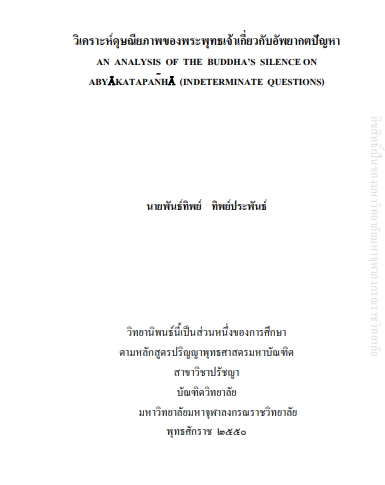
| ชื่อเรื่องภาษาไทย | วิเคราะห์คุษณียภาพของพระพุทธเจ้าเกี่ยวกับอัพยากตปัญหา |
|---|---|
| ชื่อเรื่องภาษาอังกฤษ | AN ANALYSIS OF THE BUDDHA'S SILENCE ON ABYAKATAPANHA (INDETERMINATE QUESTIONS) |
| ผู้วิจัย | นายพันธ์ทิพย์ ทิพย์ประพันธ์ |
| ที่ปรึกษา 1 | พระมหาณรงค์ กนฺตสึไล, |
| ที่ปรึกษา 2 | ตร.สมหวัง แก้วสุฟอง, |
| วันสำเร็จการศึกษา | 27 มีนาคม 2550 |
| ส่วนงานที่จัดการศึกษา | บัณฑิตวิทยาลัย |
| ชื่อปริญญา | พุทธศาสตรมหาบัณฑิต (พธ.ม.) |
| ระดับปริญญา | master |
| สาขาวิชา | ปรัชญา |
| URI | https://e-thesis.mcu.ac.th/items/3646 |
| ปรากฏในหมวดหมู่ | วิทยานิพนธ์ |
| ดาวน์โหลด (จำนวน) | 0 |
| จำนวนผู้เข้าชม (จำนวน) | 560 |
งานวิจัยเรื่อง วิเคราะห์ดุษณียภาพของพระพุทธเจ้าเกี่ยวกับอัพยากตปัญหา มีวัตถุประสงค์ เพื่อศึกษาลักยณะทางปรัชญาของอัพยากตปัญหา ซึ่งมีลักษณะทางปรัชญาอยู่ 4 ลักษณะคือลักษณะทางอภิปรัชญา ลักษณะทางอุตรภาพ ลักษณะข่ายแห่งทิฏฐิคือความสุดโด่งสองด้านมีข่ายสัสสตทิฏฐิหรือไม่ก็อุจเฉททิฏฐิ และลักษณะทางปัญหาทางคำถามที่ผู้ตอบจะต้องตอบว่า "ไช่" หรือ "ไม่ใช่" เท่านั้น
ทัศนะทางปรัชญาต่อคุษณียภาพของพระพุทธเจ้าต่ออัพยากตปัญหา สามารถสรุปเป็นสองกลุ่ม คือกลุ่มที่ขอมรับความเป็นสัพพัญญูของพระพุทธเจ้าที่เสนอว่าพระองค์ทรงรู้ทุกอย่างเพียงแต่จะนำมาตรัสหมดหรือไม่ซึ่งมีแนวคิดของปฏิฐานนิยม ปฏิบัตินิยม ประจักษ์นิยมและมนุษยนิยม และกลุ่มที่ไม่เห็นด้วยกับความเป็นสัพพัญญของพระพุทธเจ้า อันมีกลุ่มวิมตินิยมที่วิเคราะห์ว่าที่พระพุทธเจ้าไม่ทรงดอบกลุ่มปัญหานั้นเพราะขังสงสัยทำใ ห้เกิดลังเลที่จะตอบ และอไญนิยมที่วิเคราะห์ว่าเพราะพระพุทธเจ้าไม่ทรงรู้ปัญหาทางด้นอภิปรัชญา
เหตุผลหรือนัยสำคัญที่พระพุทธเจ้าไม่ทรงตอบ อัพยากตปัญหา มีดังนี้
1) เพราะปัญหาดังกล่าวตั้งขึ้นจากการเข้าใจผิด โดยการเอาความคิดของตัวเองเป็นมูลฐาน ผู้ตั้งปัญหากิดปัญหาจากความเห็นผิดของตนเอง
2) เป็นปัญหาที่ใกลตัวและไม่เกิดประโยชน์ในเชิงการปฏิบัติ
3) เป็นปัญหาที่จะนำไปสู่ความขัดแข้งทางความคิดและการดำเนินชีวิต
4) เป็นปัญหาที่คนธรรมดาจะรู้ จะเห็น หรือฟังไม่เข้าใจหรือทำให้ประจักษ์ไม่ได้
The Thesis entitled " An Analysis of the Buddha's Silence on Abyakatapanha (Indeterminate Questions) is aimed to study the philosophical aspects of Indeterminate Questions which are found in four categories, i.e., metaphysical aspect transcendental aspect, the aspect of two extreme views of upholding eternalism or nihilism and the aspect of questions which determined the only answer either "yes" or "no".
The philoshophical views towards the Buddha's silence on Abyakatapanha can be sumed up into two groups, the first one, accepts the Buddha's omniscience arguing that he knows all things but he sclects a few to teach. This group covering
Positivism, Pragmatism, cmpiricism and humanism. The second one, does not accept his omniscience. Among them, skepticism argues that the main reason of his silence is the hesitaion due to the wonder. Agnoticism argues that the cause of silence is
unknowing the metaphysical problems
The Buddha showed his attitudes to these questions by keep silence or by preaching the useful Dhamma instead. His reasons to keep silence about Indeterminate Questions are:
1) they are raised by individual misunderstanding that arising from wrong view. Therefore, it cannot be found the real answers.
2) They are uscless for practice and waste the time.
3) They may lead to dispute to cach other.
4) They cannot be empirically realized through the five senses.
| ชื่อเอกสาร | ไฟล์ | ขนาด | ประเภท | วันที่ | ดาวน์โหลด |
|---|---|---|---|---|---|
| Full Text | Gq17Mc7azqhp4N41iGMh1mraZW0CqrWRzTJRbenM.pdf | 3,636.56 KB | 21 เม.ย. 2565 |