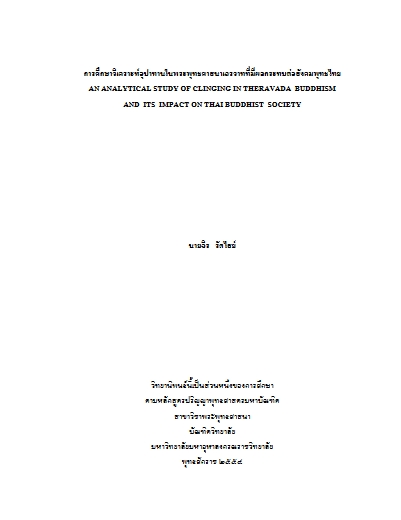
| ชื่อเรื่องภาษาไทย | การศึกษาวิเคราะห์อุปาทานในพระพุทธศาสนาเถรวาทที่มีผลกระทบ ต่อสังคมพุทธไทย |
|---|---|
| ชื่อเรื่องภาษาอังกฤษ | An analytical Study of Clinging in Theravada Buddhism and its impact on Thai Buddhist Society |
| ผู้วิจัย | นายจิร รัดไสย์ |
| ที่ปรึกษา 1 | พระมหาประมวล ฐานทตฺโต, ดร. |
| ที่ปรึกษา 2 | ดร.ประยูร แสงใส, |
| วันสำเร็จการศึกษา | 17 เมษายน 2555 |
| ส่วนงานที่จัดการศึกษา | บัณฑิตวิทยาลัย |
| ชื่อปริญญา | พุทธศาสตรมหาบัณฑิต (พธ.ม.) |
| ระดับปริญญา | master |
| สาขาวิชา | พระพุทธศาสนา |
| URI | https://e-thesis.mcu.ac.th/items/2661 |
| ปรากฏในหมวดหมู่ | วิทยานิพนธ์ |
| ดาวน์โหลด (จำนวน) | 0 |
| จำนวนผู้เข้าชม (จำนวน) | 1,337 |
วิทยานิพนธ์นี้มีวัตถุประสงค์เพื่อศึกษาสาระสำคัญของอุปาทานในพระพุทธศาสนาเถรวาท เพื่อศึกษาโทษและผลกระทบของอุปาทานที่มีต่อสังคมชาวพุทธ และเพื่อศึกษาวิเคราะห์อุบายวิธีเพื่อละอุปาทาน
ผลการวิจัยพบว่า อุปาทานในพระพุทธศาสนาหมายถึง การยึดมั่นถือมั่นในอารมณ์ด้วยอำนาจกิเลส อารมณ์ทั้งหลายที่เป็นที่ตั้งสำหรับยึดมั่นของอุปาทาน คือขันธ์ 5 เรียกว่า อุปาทานขันธ์ 5 อุปาทานแบ่งออกได้เป็น 4 ประเภท คือ 1.กามุปาทาน คือ ความยึดมั่นในกาม คือ รูป เสียง กลิ่น รส โผฏฐัพพะ 2. ทิฏฐุปาทาน คือ ความยึดมั่นในทิฏฐิ ความเห็นที่ไม่ถูกต้องตามพระธรรมคำสั่งสอนในพระพุทธศาสนา 3. สีลัพพตุปาทาน คือ ความยึดมั่นในข้อวัตรปฏิบัติหรือ ศีลพรต ข้อประพฤติหรือพิธีกรรมต่างๆ ที่งมงาย 4. อัตตวาทุปาทาน คือ ความยึดมั่นว่าเป็นตัวตน ว่ามีอยู่จริง เที่ยงแท้ หรือ จักขาดสูญ
อุปาทานมีความเกี่ยวข้องสัมพันธ์กับหลักคำสอนอื่นๆ ที่สำคัญในพระพุทธศาสนาในฐานะที่ต้องเป็นไปตามกฎสัจธรรม เช่น สัมพันธ์กับ หลักปฏิจจสมุปบาท ในฐานะที่ต้องเป็นไปตามกฎของเหตุปัจจัย เป็นเหตุและผลต่อกัน อาศัยกันและกันเกิดขึ้นเป็นไป สัมพันธ์กับกฎไตรลักษณ์ ในฐานะที่ต้องเป็นไปตามกฎของธรรมชาติ เพราะเป็นอนิจจัง ทุกขัง อนัตตา สัมพันธ์กับหลักอริสัจ 4 ในฐานะที่เป็นสมุทัยให้ทุกข์ทั้งปวงเกิด สัมพันธ์กับหลักขันธ์ 5 ในฐานะที่เป็นที่ยึดมั่นของอุปาทานทำให้เข้าใจผิดยึดมั่นว่าขันธ์ทั้ง 5 เป็นของเที่ยง เป็นสุข เป็นสัตว์ บุคคล ตัวตน ในทัศนะของปราชญ์พุทธ อุปาทานก่อให้เกิดโทษทั้งในปัจจุบันและในอนาคตแก่บุคคลผู้ที่ยึดมั่นถือมั่น และมีผล กระทบต่อสังคมพุทธในหลายด้าน เช่น ผลกระทบด้านความเชื่อ ผลกระทบด้านการศึกษา ผลกระทบด้านเศรษฐกิจและการเมือง ผลกระทบด้านวิถีชีวิตและระบบนิเวศ ทำให้เกิดปัญหาต่างๆ ในสังคม อุบายวิธีในการเรียนรู้เพื่อละอุปาทาน ต้องเจริญตามอริยมรรคมีองค์ 8 และ สติปัฏฐาน 4 การเจริญขึ้นแห่งอริยมรรคมีองค์ 8 มีองค์ประกอบที่สำคัญ 2 ประการคือ 1.ปรโตโฆสะ 2.โยนิโสมนสิการ เมื่อบุคคลได้ศึกษาพิจารณาด้วยปัญญาและเข้าใจหลักธรรมในพระพุทธศาสนาอย่างถูกต้องแล้ว ย่อมละคลายจากอุปาทาน ความยึดมั่น ถือมั่น ที่เป็นต้นเหตุของโทษทุกข์ทั้งปวงได้ความทุกข์และปัญหาต่างๆก็ลดลงตามลำดับจนสามารถละอุปาทานได้ในที่สุดจนกระทั่งบรรลุนิพพานซึ่งเป็นจุดหมายสูงสุดในพระพุทธศาสนา
The objectives of th is thesis are to critically exam ine the concept of Upadana found in Theravada Buddhism and its impact on modern Thai society. The main focus of the study would be centred on the meaning category and the relationship between Upadana and other
related concepts in Buddhism, its penalty and impact on Buddhist society, and the ways to learn or understand Upadana for eradicate them.
The result of the study fo und that Upadana in Theravad a Buddhism means clinging or attachment. Upadana in Th eravada Buddhism has four types: 1. Kamupadana (clinging to sensuality) 2. Ditthupada na (clinging to views) 3. Silabbatu padana (clinging to mere rule and ritual) 4. Attavadupadana (clinging to the ego-belief). In accordance to the relationship with other principle in Buddhism, Upadana can be seen in the following ways:
In the docrine of causes and conditions (Paticcasmuppada), Upadana comes into existence depending on various causes and conditions.
According to the principle of three char ecteristics (Tilakkhana), Upadana is subject to impermanence, suffering and selflessness, which are common to all beings.
For the four Noble truth (Ariyasacca), Upadana can be seen as the cause of suffering and it is one of defilements.
And, in the Five Aggregates (Panca-khandha), Five Aggregates are the clinging objects of Upadana which all human beings misunderstand in permanence of beings.
According to Buddhist scholars’ views, Upadana causes penalty and suffering in the present and in the future. It affects Buddhist societ y in several ways: such as impacts on belief,education, economy and politics, ways of lives and ecology.
The methods and ways to learning to eradicate Updana and to practice in accordance to the teaching of the Noble Eightfold Path (Atthangika-magga) and Four foundations of mindfulness. And, the cultivation of Eightfold Path has two important components: 1.Paratoghosa (hearing from other) 2. Yonisomanasikara (analytical reflection). After people have learnt and considered with wisdom and critical understandi ng the right. So they can eradicate Upadana at last and be able to achieve Nibbana, the supreme goal in Buddhism.
| ชื่อเอกสาร | ไฟล์ | ขนาด | ประเภท | วันที่ | ดาวน์โหลด |
|---|---|---|---|---|---|
| Full Text | tdeFmAikVSW8BLRs0moSpNPHwf0nQ3IXWRGN7vms.pdf | 1,500.29 KB | 21 ธ.ค. 2564 |